Lesson Plan | Teachy Methodology | Reactions: Balancing
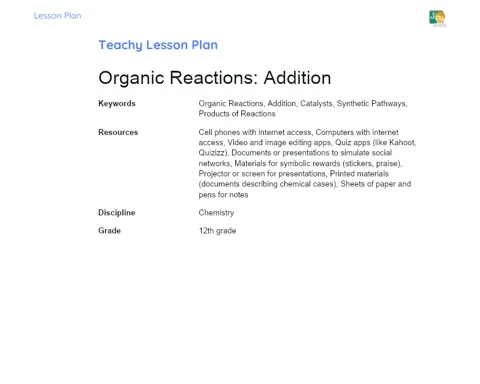
| Keywords | Chemistry, Balancing Reactions, Digital Methodology, TikTok, Instagram, Gamification, Trial-and-Error Method, Student Engagement, Active Learning, Digital Technologies |
| Required Materials | Cell phones with internet access, TikTok app, Gamification platforms (Kahoot, Socrative, or Quizizz), Graphic Design Tools (like Canva), Access to Google Classroom or similar platform, Support material on chemical reactions (books, PDFs, etc.) |
Objectives
Duration: 10 - 15 minutes
The purpose of this stage is to clarify the main and secondary objectives of the lesson, providing a clear direction for the activities and the knowledge that students should acquire. By defining the objectives, the teacher ensures that students understand the importance of balancing chemical reactions and feel motivated to apply the trial-and-error method in a practical and contextualized way.
Main Objectives
1. Understand the importance of balancing chemical reactions to ensure conservation of mass in a reaction.
2. Apply the trial-and-error method to balance different chemical equations in a practical and efficient way.
Side Objectives
- Develop analytical and problem-solving skills when working with chemical reactions.
- Encourage collaborative work and the exchange of knowledge among students during practical activities.
Introduction
Duration: 15 - 20 minutes
The purpose of this stage is to engage students from the start, connecting theoretical content they have already studied with practical and everyday examples. Additionally, by using their phones to seek information, they begin to integrate into the digital context of the lesson, actively participating and sharing knowledge. The key questions will serve to initiate a debate, reinforcing prior learning and sparking curiosity for the practical activities to follow.
Warming Up
🔍 Warm-up: Introduce the lesson topic by discussing the importance of chemical reactions in our daily lives, such as how they occur in processes like food digestion, respiration, and even in energy production in cells. Then, ask students to use their phones to search for an interesting fact about chemical reactions and the balancing of these reactions. Give about 2-3 minutes for this quick research, and then ask them to share their findings with the class.
Initial Reflections
1. ❓ What does it mean to balance a chemical equation?
2. ❓ Why is balancing chemical reactions important for conservation of mass?
3. ❓ What are common challenges when balancing chemical equations?
4. ❓ How can the trial-and-error method help in balancing reactions?
5. ❓ Did anyone find an interesting example of a chemical reaction during their research that they would like to share?
Development
Duration: 75 - 85 minutes
The purpose of this stage is to provide a practical and engaging experience where students apply their knowledge of balancing chemical reactions in playful and technological activities. This allows them to consolidate their learning in a contextualized and fun way while developing collaborative and creative skills.
Activity Suggestions
It is recommended that only one of the suggested activities be carried out
Activity 1 - 🌟 Unraveling the World of Reactions with TikTok 🌟
> Duration: 60 - 70 minutes
- Objective: Apply knowledge about balancing chemical reactions in a practical and creative way, using popular digital technologies among students.
- Description: In this activity, students will create creative TikTok-style videos to explain and demonstrate the balancing of chemical reactions. Each group will choose a specific chemical reaction, balance the equation, and using visual and sound effects, present the process in a fun and educational way.
- Instructions:
-
Divide the class into groups of up to 5 students.
-
Each group will choose a specific chemical reaction from the options provided by the teacher.
-
Students must balance the chemical reaction using the trial-and-error method.
-
After balancing, groups should create a storyboard to plan the TikTok video, including visual and sound elements.
-
Using their phones, students will record the explanatory video, highlighting the balancing of the reaction and the importance of the process.
-
Videos should be between 1 and 2 minutes long and should be edited directly on their phones using video editing apps.
-
Once completed, the videos will be shared on an online platform (like Google Classroom) for the whole class to watch.
Activity 2 - 👾 Gamification: Balancing Challenge 👾
> Duration: 60 - 70 minutes
- Objective: Foster the skill of balancing chemical reactions through a competitive and collaborative environment that utilizes gamification elements to engage students.
- Description: Students will participate in a competitive online game where they will balance different chemical equations. Using a gamification software, each group will face progressive challenges, accumulating points as they correctly balance the equations.
- Instructions:
-
Divide the class into groups of up to 5 students.
-
Each group will access a gamification platform (like Kahoot, Socrative, or Quizizz), where they will encounter balancing challenges.
-
Students will collaboratively solve each challenge using the trial-and-error method and record their answers in the gamification software.
-
The software will tally each group's points based on the accuracy and speed of the answers.
-
Groups will compete against each other in multiple rounds, with challenges becoming progressively more difficult.
-
At the end of the activity, the groups with the highest scores will be recognized and will have the opportunity to explain how they arrived at their answers.
Activity 3 - 🧪 Scientific Influencers on Instagram 🧪
> Duration: 60 - 70 minutes
- Objective: Incorporate chemistry content into a practical activity that leverages social media to create an interactive and visual learning environment.
- Description: In this activity, students will create a series of Instagram posts simulating being digital science influencers. Each group will choose a chemical reaction, balance the equation, and create explanatory and visual posts to educate their followers about the topic.
- Instructions:
-
Divide the class into groups of up to 5 students.
-
Each group will select a chemical reaction from a list provided by the teacher.
-
Students should balance the chemical reaction using the trial-and-error method.
-
Create a content plan for a series of Instagram posts, including images, graphs, and short informative descriptions.
-
Using free graphic design tools (such as Canva), students will create visual content for their posts.
-
Each group will make at least 3 explanatory posts, exploring the balancing process and the importance of mass conservation in chemical reactions.
-
The posts will be shared on an online platform (like Google Classroom or a class blog) for all students to view and comment.
Feedback
Duration: 25 - 30 minutes
The purpose of this stage is to consolidate learning and promote critical reflection on the process of balancing chemical reactions. This also strengthens students' communication and interpersonal skills, encouraging a collaborative learning environment where constructive feedback is valued.
Group Discussion
🔄 Group Discussion: Start the discussion by asking each group to briefly share their experience in conducting the activities. Follow a simple outline: 1. Ask students to explain the chosen chemical reaction and how they balanced the equation. 2. Inquire about the difficulties encountered and how they were overcome. 3. Request them to share what they enjoyed most about the activity and how it helped them better understand the balancing of chemical reactions.
Reflections
1. 🤔 Reflection Questions: 2. How did the use of digital technologies help you better understand the balancing process of chemical reactions? 3. If you had to explain the balancing of chemical reactions to someone who has never studied the topic, how would you do it? 4. What skills, apart from chemical knowledge, do you believe you improved during these activities?
360° Feedback
🌟 360° Feedback: Instruct students to form a circle, and in each group, each member should provide constructive feedback on their peers' performance. Guide students to focus on three aspects: 1. What was done well. 2. What can be improved. 3. Suggestions for future activities. Remind them to be respectful and objective, using specific examples.
Conclusion
Duration: 10 - 15 minutes
The purpose of this stage is to tie all the lesson content into a clear and interesting conclusion, helping students see the practical value of what they learned. It reinforces the connection between the lesson topic and its applications in the real world, and also provides a moment for reflection and consolidation of learning.
Summary
🎉 Fun Summary: So, guys! Today we dived into the world of chemical reactions and discovered how balancing equations is essential to understanding what happens in chemical processes. From TikTok-style videos to Instagram posts, we used creativity and technology to make knowledge flow in a super dynamic way! 🌟✨
World Connection
🌍 In the Current World: Chemical reactions are not just in the lab! They are in the food we digest, the gasoline that burns to move our cars, and even in the batteries of our phones. Understanding the balancing of these reactions is understanding the balance of nature and the technologies we use every day.
Practical Application
🔬 Applications in Daily Life: Knowing how a chemical reaction balances helps us understand everything from how our body processes food to how industries produce essential materials for our daily lives. Balancing reactions is, literally, balancing the chemistry of life! ⚖️