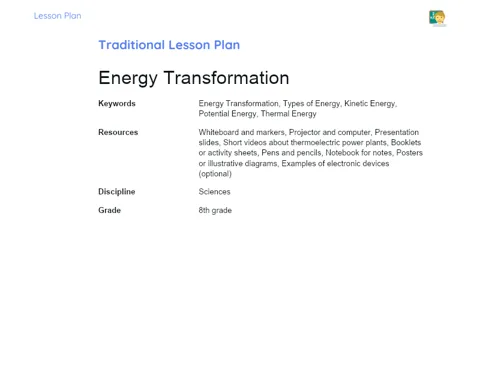
Lesson Plan | Teachy Methodology | Energy Transformation
| Keywords | Energy Transformation, Thermal Energy, Electric Energy, Thermal Power Plants, Active Methodology, Social Media, Content Creation, Gamification, Educational Video, Technology and Sustainability |
| Required Materials | Mobile phones with internet access, Video editing apps, Online wireframe creation tools (e.g., Canva, Miro), Computers or tablets, Projector and screen for presentations, Feedback forms |
Objectives
Duration: 10 to 15 minutes
This stage aims to establish a basic understanding of the different types of energy and their transformations. It helps to contextualize the topic with practical examples, allowing students to connect with the real world and their daily experiences.
Main Objectives
1. Understand the different types of energy and their forms of transformation.
2. Analyze practical examples of energy transformation, such as in thermal power plants.
Side Objectives
- Relate energy transformation to students' everyday situations.
Introduction
Duration: 10 to 15 minutes
This stage aims to establish a basic understanding of the different types of energy and their transformations. It helps to contextualize the topic with practical examples, allowing students to connect with the real world and their daily experiences.
Warming Up
Energy transformation is a fundamental concept in science, addressing how different forms of energy can be converted from one form to another. To start the class, ask students to use their phones to find an interesting fact related to energy transformation. This can include everyday examples, technological advances, or scientific curiosities. Encourage them to share these facts with the class.
Initial Reflections
1. What types of energy do you know?
2. Can you give an example of a situation where energy is transformed from one form to another in your daily life?
3. How do you think electric energy is produced in a thermal power plant?
4. What is the importance of energy transformation for modern society?
5. Can you think of any recent technology that uses energy transformation in an innovative way?
Development
Duration: 70 to 85 minutes
This stage aims to provide students with a practical and interactive experience in applying the concepts of energy transformation. Using digital technologies, students are encouraged to work in groups and develop creative projects that connect theory to daily practice.
Activity Suggestions
It is recommended that only one of the suggested activities be carried out
Activity 1 - Energy on Social Media 📱
> Duration: 60 to 70 minutes
- Objective: Encourage understanding and communication skills about energy transformation, using languages and formats common in social media.
- Description: Students will create a series of posts for a fictitious social media that explain the different forms of energy transformation. Using images, short videos, and texts, students must develop educational content that is visually appealing and informative.
- Instructions:
-
Split the students into groups of up to 5 people.
-
Each group must choose a fictitious social media platform for which they will create content (e.g., 'InstaEnergy', 'FacePower').
-
Groups must create a series of 5 posts explaining different types of energy transformation. Each post must include an image or short video, accompanied by an explanatory text.
-
Students should use their phones to research images and videos, as well as to create the texts.
-
Encourage students to be creative with the formats of the posts, including memes, infographics, or even filmed mini-experiments.
-
In the end, each group will present their posts to the class, explaining the created content.
Activity 2 - Energy Influencers 💡
> Duration: 60 to 70 minutes
- Objective: Develop the ability to explain scientific concepts clearly and interestingly, using video editing tools and visual elements.
- Description: Students will transform into digital influencers and create short and engaging videos about the importance of energy transformation in our daily lives. They should use basic editing apps to produce content that is educational and engaging.
- Instructions:
-
Split the students into groups of up to 5 people.
-
Each group must choose a type of energy transformation (e.g., thermal energy to electric, kinetic energy to potential).
-
Students must plan and record a short video (2-3 minutes) in which they explain the chosen energy transformation.
-
Students can use available video editing apps on their phones to add effects, captions, and music to the video.
-
Encourage students to be creative in the video format, such as simulating a vlog, a tutorial, or an interview.
-
In the end, groups will present their videos to the class, explaining the concepts covered.
Activity 3 - Energy Gamification 🎮
> Duration: 60 to 70 minutes
- Objective: Foster creativity and critical thinking in students while they apply scientific knowledge to create an educational game.
- Description: Students will develop a prototype of an educational game that teaches about energy transformation. Using online tools to create storyboards and wireframes, they must design a game that is informative and fun.
- Instructions:
-
Split the students into groups of up to 5 people.
-
Each group must choose a theme for their game (e.g., an energy power plant simulator, an adventure game where the character must use different forms of energy to overcome obstacles).
-
Students must create a basic storyboard that describes the game's plot and the main challenges related to energy transformation.
-
Using free online wireframe creation tools (e.g., Canva, Miro), students should develop a basic layout of the game's screens.
-
Encourage students to include gamification elements, such as points, levels, and rewards, that promote learning.
-
In the end, each group will present their game prototype, explaining how it teaches about energy transformation.
Feedback
Duration: 20 to 25 minutes
This stage aims to consolidate learning through the exchange of experiences and critical reflections. Group discussion and 360° feedback promote a collaborative and respectful environment where students can evaluate their own performance and that of their peers, reinforcing the concepts learned and recognizing areas for improvement.
Group Discussion
Facilitate a group discussion where students share their experiences, learnings, and conclusions from the practical activity. Follow this script: Start by asking students how they felt while carrying out the activity and what the main challenges faced were. Next, ask each group to present the content produced (posts, videos, game prototypes) and explain the energy transformation concepts covered. Encourage the class to ask questions and provide constructive suggestions about each presentation.
Reflections
1. What were the most interesting types of energy transformation you discovered during the activity? 2. How did creating digital content (posts, videos, games) help you understand energy transformation better? 3. In what way did group work influence your learning about the topic?
360° Feedback
Conduct a 360° feedback session where each student receives feedback from their group peers. Guide students to focus on positive and constructive aspects, using respectful language. Suggest that they mention at least one positive highlight and one improvement suggestion. To facilitate this, students can fill out a small form with their observations.
Conclusion
Duration: 10 to 15 minutes
✍️ Purpose of the Conclusion ✍️ The purpose of the conclusion stage is to consolidate the main points discussed during the class and allow students to relate what they learned to the world around them. It also reinforces the relevance of the topic to their daily and future lives, promoting a deeper reflection on the practical applications of the acquired knowledge.
Summary
🌟 Energy in Daily Life 🌟 Imagine a superhero who can transform into anything! That's how energy works: it can be kinetic (movement), thermal (heat), electrical, and much more. During the class, we explored how a thermal power plant transforms heat into electricity. And we didn't just stay in theory! Students became digital influencers, content creators, and game designers to explain these concepts. 🚀
World Connection
🔗 Connection to the Modern World 🔗 Today, understanding energy transformation is vital in a world that increasingly relies on advanced and sustainable technologies. We used examples from social media, videos, and games because these are tools that dominate the lives of young people and our society. The ability to explain scientific concepts in an engaging way is a valuable skill for the future.
Practical Application
⚙️ Applications in Everyday Life ⚙️ Knowing how energy transforms is essential in many areas, from engineering to household routines, like using household appliances. Understanding these processes contributes to more conscious and sustainable decision-making, whether it's choosing an energy source or optimizing energy consumption at home.