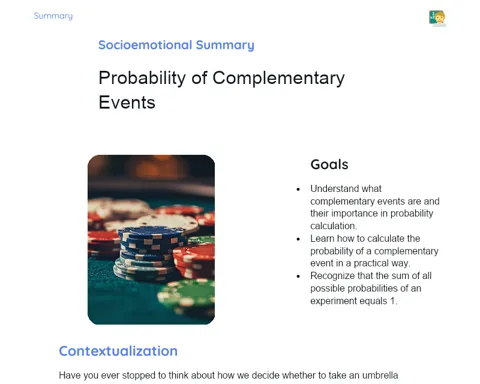
Unraveling Random Events: A Path to Informed Decision-Making
Objectives
1. Identify random events in practical situations, such as rolling a die or drawing a card from a deck.
2. Calculate the probability of basic random events and understand their application in everyday situations.
3. Develop critical thinking skills when analyzing and interpreting the probability of different events.
4. Encourage collaborative work and communication among students during practical activities.
Contextualization
Random events are part of our daily lives in ways that we often don't notice. They are present when we roll a die, choose a card from a deck, or even decide on the next movie to watch through a virtual roulette. Understanding how these events work helps us make more informed decisions and better understand the world around us. For example, when rolling a die, each face has an equal chance of appearing, allowing us to calculate the probability of getting a specific number.
Relevance of the Theme
Understanding random events and probability is essential in the current context, as these concepts are applied in various fields such as insurance, finance, and video game development. In the financial market, for instance, analysts use probabilities to predict market fluctuations and make investment decisions. Therefore, mastering these concepts helps us make more informed decisions and face everyday challenges more effectively.
Definition of Random Events
Random events are situations or phenomena whose outcome cannot be predicted with certainty. They are characterized by uncertainty and the impossibility of determining in advance what the specific result will be. Common examples include rolling a die or drawing a card from a deck.
-
Random events are unpredictable.
-
Uncertainty is a central characteristic of random events.
-
They can be mathematically modeled to calculate probabilities.
Probability Calculation
Probability is a measure of the chance of an event occurring. It is expressed as a number between 0 and 1, where 0 indicates that the event cannot occur and 1 indicates that the event will certainly occur. For equally likely events, probability is calculated by dividing the number of favorable outcomes by the total number of possible outcomes.
-
Probability is a measure of chance.
-
It is expressed as a number between 0 and 1.
-
For equally likely events, the formula is: Probability = Number of favorable outcomes / Total number of possible outcomes.
Everyday Applications
Understanding random events and probability is essential for making informed decisions in various areas of everyday life and work. For example, when playing a board game, calculating the probability of certain moves can influence strategy. In fields like insurance and finance, probability is used to calculate risks and predict future events.
-
Helps in making informed decisions.
-
Is widely used in games and strategies.
-
Applied in insurance and finance for risk calculation.
Practical Applications
- Insurance companies use probabilities to calculate insurance premiums based on the risk of events such as accidents or natural disasters.
- In the financial market, analysts use probability to predict market fluctuations and guide investment decisions.
- Video game developers apply probability concepts to create balanced and challenging game mechanics.
Key Terms
-
Random Event: A phenomenon whose outcome cannot be predicted with certainty.
-
Probability: A measure of the chance of an event occurring, expressed as a number between 0 and 1.
-
Equally Likely: A situation in which all possible outcomes of a random event have the same chance of occurring.
Questions
-
How can understanding random events help in decision-making in uncertain situations?
-
In what ways is probability used in your daily life without you realizing it?
-
What is the importance of understanding probability in the context of a future professional career?
Conclusion
To Reflect
Throughout this lesson, we explored the fascinating world of random events and probability. Understanding how these concepts work enables us to better analyze our daily lives and make more informed decisions. From board games to complex financial forecasts, probability provides us with a powerful tool to deal with uncertainty and chance. Reflecting on these applications helps us realize the importance of mastering these concepts, not only for trivial activities but also to face real challenges in the job market and everyday life.
Mini Challenge - Die and Card Challenge
Let's reinforce our understanding of random events and probability through a practical and fun activity.
- At home, use a die and a deck of cards to conduct the experiments.
- Roll the die 30 times and record each result.
- Then, calculate the probability of getting a specific number (for example, 4).
- Next, shuffle the deck and draw a card 30 times, noting the value and suit of each card.
- Calculate the probability of drawing an Ace or a Heart.
- Compare your theoretical probabilities (calculated earlier) with the observed results.
- Write a paragraph reflecting on the differences between theoretical probabilities and observed results and what you learned from this activity.