Globalized World | Active Summary
Objectives
1. Analyze and discuss the post-Cold War world configuration, highlighting major events and geopolitical changes.
2. Identify and explain new political and economic alignments influenced by the United States and how these affect current international relations.
3. Develop skills in argumentation and critical thinking by comparing and contrasting different global actors.
Contextualization
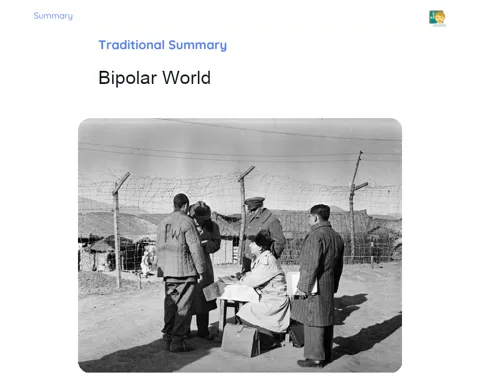
Did you know that the Cold War, which lasted from 1947 to 1991, was not a war in the traditional sense of the term, but rather an intense period of political, economic, and ideological tension between the United States and the Soviet Union, which divided the world into two opposing blocs? This period was marked by an arms race, space competition, and direct influence in regional conflicts around the globe. The collapse of the Soviet Union and the end of the Cold War completely redefined the global political and economic landscape, paving the way for new powers and challenges, such as the rise of China and the consolidation of economic blocs.
Important Topics
Rise of China as an Economic Power
After the end of the Cold War, China emerged as one of the most powerful economies in the world. Its reform and opening policies, initiated in the 1970s and 1980s, led to rapid economic growth. This not only transformed China internally but also reconfigured global economic and political dynamics, challenging the hegemony traditionally held by the United States.
-
Accelerated economic growth based on exports and infrastructure investments.
-
Importance of China as a trading partner for many nations, altering the global power balance.
-
Impact on international relations and the formation of economic blocs, such as BRICS.
2008 Financial Crisis and the European Union
The 2008 financial crisis had a significant impact on the global economy, particularly affecting the European Union. The crisis revealed structural flaws in the eurozone and triggered a series of events that challenged the integration and cohesion of the bloc. The EU's response to the crisis and the policies adopted for economic recovery are essential to understanding the current political and economic landscape in Europe.
-
Challenges faced by the European Union in coordinating economic policies among member states.
-
Impact of the crisis on confidence in the euro and European institutions.
-
Economic reforms and recovery measures adopted and their long-term effects.
International Relations with American Influence
The United States maintains a prominent position in international relations, exerting significant influence in various regions of the world. Post-Cold War US foreign policy, focusing on military interventions, strategic alliances, and economic diplomacy, is critical to understanding the current geopolitical landscape, including the confrontation with emerging powers like China and Russia.
-
Role of the United States in maintaining international alliances, such as NATO.
-
Conflicts and military interventions that have shaped international relations, such as in the Middle East.
-
Economic diplomacy and trade agreements that reflect the global strategy of the US.
Key Terms
-
Globalized World: Refers to the current state of interconnection and interdependence among the nations of the world in terms of economy, culture, politics, and technology.
-
Cold War: Period of political and military tensions between the United States and the Soviet Union, without direct confrontations, which profoundly influenced the geopolitical configuration of the world.
-
Economic Blocs: Groupings of countries that establish trade agreements aimed at facilitating trade among themselves, increasing investments, and cooperating on economic policies.
To Reflect
-
How has the rise of China as an economic power altered global power relations and existing economic blocs?
-
How did the 2008 financial crisis impact perceptions of European integration and international cooperation?
-
What role do the United States play in forming and maintaining international alliances and how does this influence current international relations?
Important Conclusions
-
We explored how the world has reconfigured after the end of the Cold War, with the rise of new powers such as China and the challenges faced by old powers like the European Union and the United States.
-
We discussed the importance of international relations and how political and economic alignments influence the current global landscape, highlighting diplomacy, conflicts, and cooperation among nations.
-
We reinforced the relevance of understanding the dynamics of the globalized world, not just as an academic concept but as an essential skill for actively participating in an interconnected and dynamic society.
To Exercise Knowledge
- Create a mind map that connects the major events of the Cold War with the geopolitical and economic changes that have occurred since then. 2. Write a short essay discussing the impact of China's rise on the global economy, focusing on a specific sector of your choice. 3. Simulate a negotiation of a trade treaty between a European country and an Asian country, considering the economic and political interests of both sides.
Challenge
Global Detective Challenge: Choose a recent event in the news involving international relations and investigate how different world powers or economic blocs are involved. Present your findings in a creative format, such as a podcast or an explanatory video.
Study Tips
-
Utilize online resources, such as documentaries and articles from international newspapers, to stay updated on the latest dynamics of the globalized world.
-
Participate in online discussion forums or study groups to exchange ideas and perspectives with other students interested in geopolitics and international relations.
-
Practice critical reading of news and articles about international events, questioning sources, viewpoints presented, and possible motivations behind the actions of countries.