Reflection on Ethics | Active Summary
Objectives
1. Identify and analyze ethical situations in daily life and society, using critical thinking and the ethical theories studied.
2. Explore the main components of ethics, such as values, duties, and virtues, and apply them in different contexts for decision-making.
3. Learn about important classical and contemporary thinkers in ethics, understanding their perspectives and contributions to ethical thought.
Contextualization
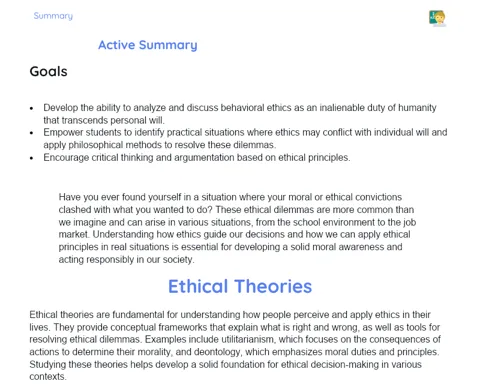
Did you know that ethics is not just a concept discussed in classrooms, but a vital force that shapes our daily actions and influences the functioning of our societies? From the ancient Greek philosophers to contemporary debates about artificial intelligence and human rights, ethics is present, guiding what is considered right or wrong. By exploring ethics, we equip ourselves not only to understand the world around us but also to act justly and responsibly, becoming more conscious citizens who can contribute to a better world.
Important Topics
Ethical Values
Ethical values are fundamental principles that guide our behavior, helping to distinguish what is morally right from what is wrong. They are the foundation upon which we build our personal and social ethics, influencing our decisions and actions. Examples of ethical values include honesty, justice, equality, respect, and solidarity.
-
Honesty: Being truthful and fair in interpersonal relationships and actions.
-
Justice: Promoting equity and equal treatment for all.
-
Respect: Recognizing and valuing the dignity and rights of others.
-
Solidarity: Acting together for the collective well-being, demonstrating empathy and support.
Ethical Theories
Ethical theories are systems of ideas that seek to explain and justify what is morally good or right. They provide a conceptual framework for thinking about ethical dilemmas and help in forming a consistent moral judgment. Some of the main ethical theories include Deontology, Utilitarianism, and Virtue Ethics, each emphasizing different aspects, such as duty, consequence, or character.
-
Deontology: Acts according to duty and moral rules, regardless of the consequences.
-
Utilitarianism: Bases morality on the consequences of actions, seeking to maximize overall well-being.
-
Virtue Ethics: Focuses on the character and virtues of the agent, promoting moral qualities such as courage, temperance, and justice.
Ethical Thinkers
Ethical thinkers are individuals whose ideas have helped shape the field of ethics over the centuries. From Socrates to Immanuel Kant and John Stuart Mill, to contemporary thinkers like Peter Singer, each has contributed unique and critical perspectives to the understanding of ethical issues. Studying these thinkers not only enriches our knowledge but also challenges us to think critically about the foundations of morality and ethics.
-
Socrates: Famous for his questioning method, which sought to lead people to reflect on their beliefs and actions.
-
Immanuel Kant: Developed the theory of Deontology, emphasizing the intrinsic value of the person and the importance of respect.
-
John Stuart Mill: One of the main representatives of Utilitarianism, which focuses on the consequences of actions.
Key Terms
-
Ethics: The study of moral value systems that guide human behavior.
-
Morality: A set of norms and values that regulate behavior within a society or group.
-
Ethical Dilemma: A situation in which one must choose between two options, both with moral consequences, where there is no clear correct answer.
To Reflect
-
How do your personal values influence your daily decisions, and how are these values formed?
-
If you had to choose between saving the life of one person or many, which ethical theory would you apply and why?
-
How can the study of ethical theories help resolve ethical conflicts in the real world, such as medical dilemmas or political decisions?
Important Conclusions
-
We explored the importance of ethics as a guide for our actions, discussing ethical values, ethical theories, and great thinkers who have shaped this field throughout history.
-
Understanding ethics is not only theoretical; we apply these concepts in real-life situations and ethical dilemmas to develop critical thinking and decision-making skills.
-
We recognize that ethics is an essential tool for navigating the complexities of modern life, influencing our personal choices and social interactions.
To Exercise Knowledge
Create an ethical diary: For one week, record at least three situations from your daily life where you consciously applied an ethical value. Reflect on these choices at the end of the week and discuss with family or friends to gain different perspectives.
Challenge
The Digital Dilemma Challenge: Using an online discussion platform, present an ethical dilemma that you have crafted and invite your peers to participate, presenting their solutions based on the ethical theories studied. Vote on the best solution and discuss why this choice stands out.
Study Tips
-
Review the ethical theories and classify examples from current news or historical events under each to enhance understanding and practical application.
-
Watch movies or read books that present ethical dilemmas and try to identify the different ethical perspectives of the characters to improve your critical analysis skills.
-
Participate in forums or online discussion groups about ethics to exchange ideas with people from different backgrounds and enrich your understanding of the subject.