Bipolarized World: Review | Traditional Summary
Contextualization
The Cold War period, which lasted from 1947 to 1991, was characterized by a constant state of tension between two global superpowers: the United States and the Soviet Union. This historical period is known as the 'Bipolarized World' due to the division of the world into two opposing ideological blocks. On one side, the US led the capitalist block, promoting liberal democracy and a market economy. On the other, the USSR led the socialist block, promoting communism and a planned economy. This division was not limited to the political and economic aspects but also extended to military and cultural spheres, affecting nearly all nations of the world in some way.
During the Cold War, the rivalry between the US and the USSR manifested in various spheres, including the arms race and the space race, as well as indirect conflicts known as 'proxy wars.' These conflicts occurred in third countries, where each superpower supported opposing sides to expand its influence without direct confrontation. Notable examples include the Korean War, the Vietnam War, and the Afghanistan War. The Cold War also had profound impacts on culture and society, influencing propaganda, cinema, literature, and people's daily lives, shaping a climate of fear and uncertainty due to the constant nuclear threat.
Capitalist Block
The United States led the capitalist block during the Cold War, promoting liberal democracy and a market economy. This block consisted of countries that shared similar political and economic ideals and aligned against the advancement of communism promoted by the Soviet Union. Among the US allies were the nations of Western Europe, Japan, Australia, and Canada, which formed a united front to contain the expansion of socialism. To strengthen these alliances, organizations such as the North Atlantic Treaty Organization (NATO) were established, serving as a collective military alliance to protect member countries against possible Soviet aggression.
The United States not only provided military support but also economic aid through the Marshall Plan, which aimed to rebuild Europe devastated by World War II. This plan intended to create stable and democratic economies in Europe, preventing the rise of communist movements. American influence also extended to Asia, where Japan became a strategic ally after the war, and to Latin America, where the US supported governments fighting communism in their respective nations.
The promotion of democracy and market economy by the United States was accompanied by a strong cultural presence. Hollywood, music, and American lifestyles spread throughout the world, contributing to the dissemination of capitalist values. American propaganda also played a crucial role, presenting capitalism as a superior and freer system compared to communism.
-
US leadership in the capitalist block.
-
Military and economic alliances such as NATO and the Marshall Plan.
-
Cultural influence and propaganda promoting capitalist values.
Socialist Block
The Soviet Union led the socialist block, promoting communism and a planned economy. The socialist block was made up of countries that adopted political and economic systems inspired by the Soviet model, such as the Eastern European countries that formed the Warsaw Pact, a military alliance created in response to NATO. The USSR also established close ties with China until the Sino-Soviet split, as well as supporting revolutionary movements and socialist governments in various parts of the world, including Cuba, Vietnam, and North Korea.
The planned economy, characteristic of the socialist block, was centralized and controlled by the state, with the aim of eliminating private ownership of the means of production and ensuring the equitable distribution of resources. The Soviet Union sought to expand its ideological influence by supporting socialist revolutions and promoting policies that contrasted with Western capitalism. This block was also marked by intense political propaganda that exalted the achievements of socialism and criticized the inequalities of capitalism.
Cultural life in the countries of the socialist block was strongly influenced by communist ideology. Art, literature, and cinema were used as tools of propaganda to promote the ideals of socialism and reinforce loyalty to the state. Education and media were strictly controlled to ensure dissemination of the official ideology and suppression of dissenting ideas.
-
USSR leadership in the socialist block.
-
Centralized and planned economy.
-
Propaganda and cultural control to promote communist ideology.
Indirect Conflicts
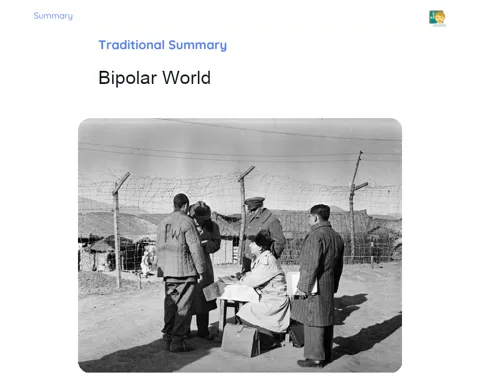
During the Cold War, the rivalry between the US and USSR manifested in a series of indirect conflicts known as 'proxy wars.' These conflicts occurred in third countries, where each superpower supported opposing sides, providing financial resources, armaments, and military advice, while avoiding direct confrontation. Notable examples include the Korean War (1950-1953), where the US supported South Korea while the USSR and China supported North Korea; the Vietnam War (1955-1975), where the US intervened to support the South Vietnamese government against the communist North Vietnam, backed by the USSR and China; and the Afghanistan War (1979-1989), where the US supported Afghan mujahideen against the Soviet invasion.
These indirect conflicts were used by the superpowers to expand their geopolitical influence without risking nuclear war. Each conflict reflected the ideological struggle between capitalism and communism, and the outcomes of these conflicts had lasting impacts on the affected regions. The Korean War resulted in a divided Korean peninsula to this day, while the Vietnam War had profound social and political consequences in the US. The Afghanistan War contributed to the eventual fall of the USSR, by exhausting resources and morale.
These conflicts also had significant humanitarian impacts, with millions of deaths, forced displacements, and destruction of infrastructure. The superpowers' intervention in local conflicts often exacerbated regional tensions and left legacies of instability and violence that continue to this day.
-
Indirect conflicts avoided direct confrontation between the US and the USSR.
-
Major examples include the Korean War, Vietnam War, Afghanistan War.
-
Lasting impacts on the affected regions and significant humanitarian consequences.
Arms and Space Race
The arms race was one of the most prominent features of the Cold War, with the US and USSR amassing vast arsenals of nuclear weapons. This competition led to the doctrine of mutually assured destruction (MAD), where both superpowers had sufficient capability to destroy each other in the event of a nuclear attack, creating a balance of terror that prevented direct confrontations. The arms race also included the development of intercontinental ballistic missiles (ICBMs) and missile defense systems, further increasing the tension and distrust between the two nations.
Alongside the arms race, the space race represented a technological and ideological competition. The launch of the Sputnik satellite by the USSR in 1957 marked the beginning of the space race, followed by a series of remarkable feats, including sending the first man into space, Yuri Gagarin, in 1961. The US responded with the Apollo program, culminating in the man's arrival on the Moon in 1969, an event widely seen as a symbolic victory of capitalism over communism.
These technological advances were not only demonstrations of power but also spurred scientific and technological innovations that benefited humanity. Space research resulted in technologies that are now common, such as communication satellites and GPS. The arms race, with all its potential for destruction, also led to the development of security and defense technologies that continue to influence current military policies.
-
The arms race led to the doctrine of mutually assured destruction (MAD).
-
The space race included milestones such as the launch of Sputnik and the arrival of man on the Moon.
-
Resulting technological advances benefited humanity in various areas.
Social and Cultural Impacts
The Cold War had profound social and cultural impacts, affecting the daily lives of people in both the capitalist and socialist blocks. The constant threat of nuclear war created a climate of fear and uncertainty, leading to the construction of nuclear shelters and the holding of drills for nuclear attack preparedness. Propaganda played a crucial role, with both blocks using media, cinema, and literature to promote their ideologies and demonize the opponent. In the US, films like 'Dr. Strangelove' and 'The Day After' reflected concerns about nuclear war, while in the USSR, cultural production exalted the achievements of socialism and resistance to Western imperialism.
Espionage and counterespionage were central elements of the Cold War, with agencies like the CIA and KGB involved in secret operations to gather information and influence political events. These activities often fueled paranoia and distrust, both among the superpowers and within their own countries. The witch hunt in the US during the McCarthy era is an example of how the fear of communism led to political persecutions and violations of civil rights.
Moreover, the division of the world into blocks influenced civil rights movements and national liberation movements. Soviet support for anti-colonial movements in Africa and Asia helped accelerate the decolonization process, while in the US, the civil rights movement was partly shaped by the need to project an image of freedom and democracy during the Cold War.
-
The nuclear threat created a climate of fear and uncertainty.
-
Propaganda and cultural production were used to promote ideologies.
-
Espionage and counterespionage fueled paranoia and distrust.
To Remember
-
Bipolarized World: Division of the world into two ideological blocks during the Cold War.
-
Cold War: Period of tension and rivalry between the US and USSR from 1947 to 1991.
-
Capitalist Block: Group of countries led by the US, promoting liberal democracy and market economy.
-
Socialist Block: Group of countries led by the USSR, promoting communism and planned economy.
-
Indirect Conflicts: Proxy wars where the US and USSR supported opposing sides.
-
Arms Race: Competition between the US and USSR to amass nuclear arsenals.
-
Space Race: Technological and ideological competition between the US and USSR for dominance in space.
-
Mutually Assured Destruction (MAD): Nuclear deterrence doctrine based on reciprocal destruction capability.
-
Propaganda: Use of media and cultural production to promote ideologies during the Cold War.
-
Espionage: Secret activities for information gathering and political influence between the US and USSR.
Conclusion
The Cold War period was one of the most significant moments in modern history, characterized by the division of the world into two opposing ideological blocks: the capitalist block led by the United States and the socialist block led by the Soviet Union. This division resulted in a series of significant events, including the arms race and space race, as well as indirect conflicts in third countries, which reflected the rivalry between the superpowers without them entering into direct confrontation.
The rivalry between the US and USSR also had profound cultural and social impacts. The constant threat of nuclear war created a climate of fear and uncertainty, while propaganda and cultural production were widely used to promote ideologies and demonize the opponent. Additionally, espionage and secret operations fueled distrust and paranoia, both among the superpowers and within their own countries.
Understanding the Bipolarized World is essential for grasping current geopolitics, as many modern conflicts and tensions have roots in the Cold War. The technological competition of that time resulted in innovations we use daily, such as communication satellites and space technologies. Therefore, it is essential for students to recognize the importance of this period and continue exploring the topic to deepen their knowledge and understanding of contemporary geopolitical dynamics.
Study Tips
-
Review the key events and dates of the Cold War, such as the creation of NATO, the launch of Sputnik, and the fall of the Berlin Wall, to understand the chronology of events.
-
Read complementary books and articles about the Cold War for different perspectives and analyses on the period. Works by renowned historians can provide valuable insights.
-
Watch documentaries and films about the Cold War. Visual productions can help contextualize events and make learning more dynamic and engaging.